
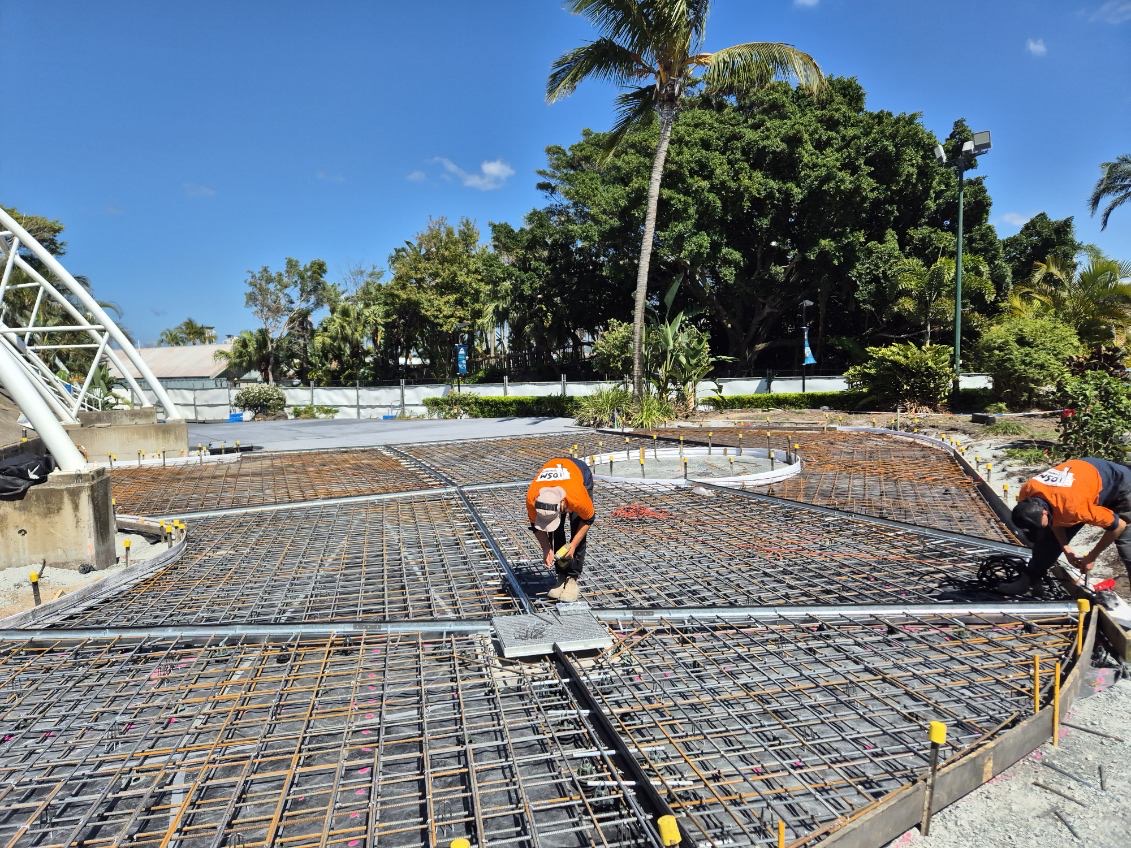
Commercial Concrete Repair & Replacement | Gold Coast
There is no prize for repairing concrete that should have been replaced. There is also no sense demolishing a sound slab because one corner has spalled or a dormant crack can be repaired properly. The skill is working out where the failure actually is before choosing the treatment.
On commercial sites, that decision matters more than it does on a lightly used domestic surface. A repair may sit beneath delivery vehicles, forklifts, cleaning equipment, trolleys, thousands of pedestrians or turning vehicle tyres. The area may also need to drain correctly, remain accessible and return to service within a defined programme.
That is why commercial concrete repair versus replacement is not primarily a question of how bad the surface looks. It is a diagnosis of the slab, the support beneath it, the traffic above it and the mechanism causing the defect.
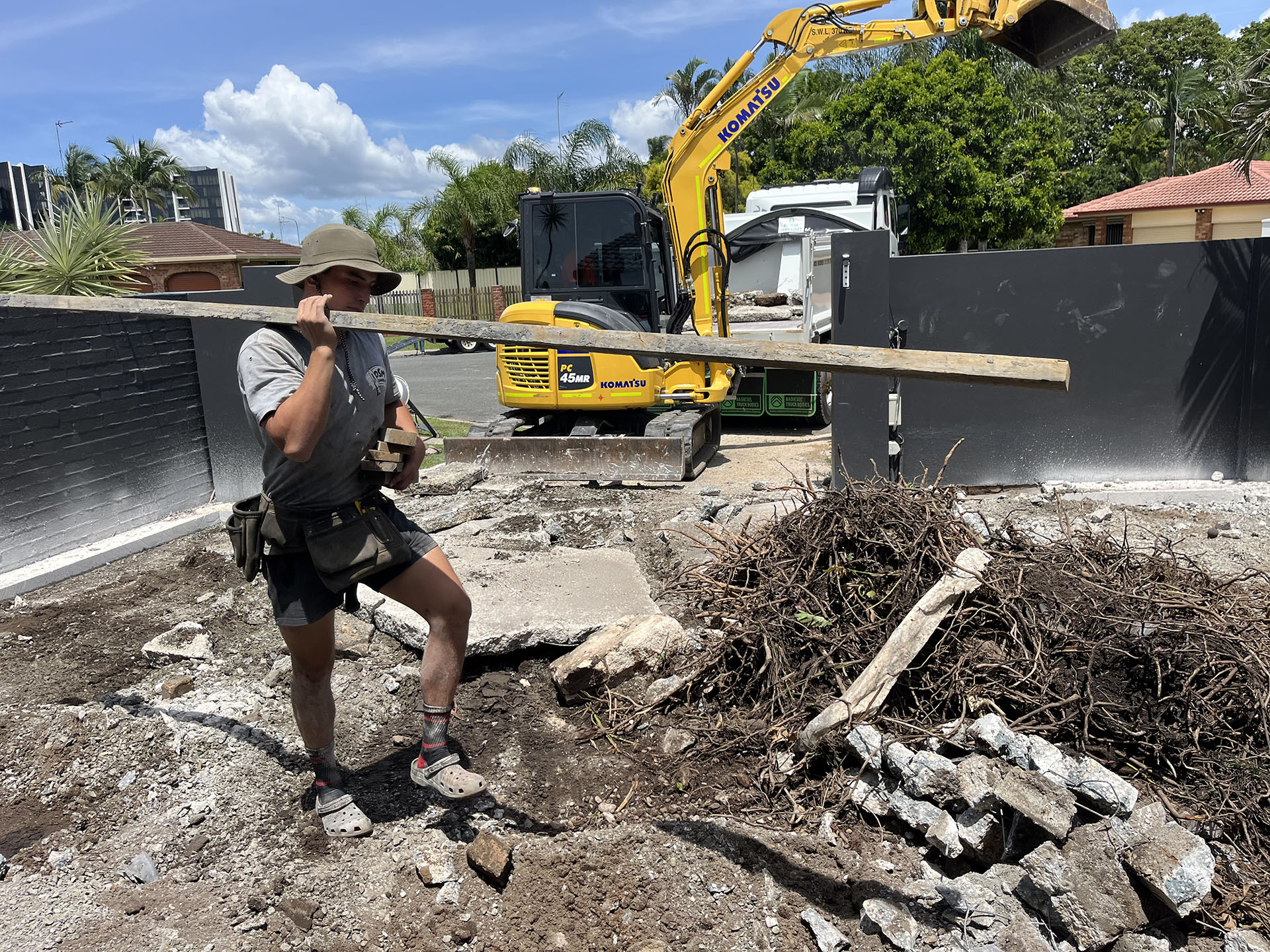
The correct commercial concrete solution depends on what has failed: the surface, the concrete section, the joint, the reinforcement, the levels or the support underneath the slab.
The short answer
Repair is usually worth considering when a defect is localised and the surrounding concrete and supporting base remain sound. Resurfacing is useful when the slab is stable but the surface has deteriorated. Full-depth or complete replacement becomes the stronger option when the problem involves movement, settlement, unstable support, incorrect levels, drainage failure, widespread deterioration or repeated failure of previous repairs.
OSM Concrete provides concrete replacement across the Gold Coast for commercial, civil, strata and larger residential projects, alongside concrete repair and resurfacing services. Having more than one treatment available matters because the right recommendation is not always the one involving the most concrete.
Repair, Resurface and Replace Are Three Different Interventions
One reason concrete rectification gets confusing is that the word repair is used for almost everything.
In practice, there are three very different levels of intervention.
Those distinctions matter because each option reaches a different depth into the problem.
A crack injection resin can deal with a suitable crack. A high-build repair mortar can reinstate concrete that has broken away. A polymer-modified overlay can renew a worn surface. None of those treatments can compact a failed sub-base beneath an existing slab or lift a slab that has permanently settled to the wrong level.
Start With the Failure Mechanism, Not the Crack Width
People naturally look at concrete damage from the top down. Contractors need to think from the bottom up.
A visible crack is an outcome. The more important question is what produced it.
A relatively fine crack caused by continued settlement can be more significant than a wider drying-shrinkage crack that occurred early in the slab’s life and has been stable ever since. Likewise, replacing a small spalled section can be effective if the surrounding concrete is sound, while repeatedly patching an entire pavement that is breaking up under traffic may only move the next failure to the edge of the latest repair.
| What you see | Possible mechanism | What needs to be established | Likely direction |
|---|---|---|---|
| Single dormant crack | Shrinkage or an isolated historic event | Whether movement has stopped and whether load transfer or water exclusion is required | Repair may be viable |
| Cracks reopening after repair | Continuing movement, poor jointing or loss of support | Why the two sides are still moving relative to each other | Investigate before repairing again |
| Localised spalling | Impact, weak concrete, reinforcement corrosion or damaged joint edge | Depth, extent, reinforcement condition and surrounding concrete quality | Local reinstatement may be appropriate |
| Sunken slab or step between panels | Sub-base settlement, washout, poor compaction or ground movement | Condition and support below the slab | Replacement often provides the better opportunity to correct the cause |
| Ponding after rain | Incorrect falls, settlement or changed drainage conditions | Actual levels and where water needs to discharge | Regrading and replacement may be required |
| Widespread surface wear with a stable slab | Abrasion, weathering or deterioration of an old finish | Whether the underlying slab remains suitable to retain | Resurfacing may be preferable |
| Multiple fractured panels under traffic | Loading, insufficient support, slab design issues or advanced deterioration | Whether local repairs can provide a realistic service life | Full-depth replacement becomes more attractive |
This is the same principle OSM applies across commercial concrete projects, where base preparation, slab support, drainage, traffic, joints, reinforcement, curing and final finish need to work as one system rather than as independent details.
Commercial Concrete Repair Products Are Highly Specialised
Modern concrete repair materials are very good at what they are designed to do. The mistake is expecting one repair product to perform a job it was never designed for.
For project managers and facility managers, understanding a few product families helps explain why the diagnosis comes first.
| Repair requirement | Typical product technology | Australian examples | What it does not fix |
|---|---|---|---|
| Dormant structural crack requiring consolidation | Low-viscosity rigid epoxy injection | Fosroc Nitofill LV | Continuing slab movement or loss of support beneath the slab |
| Active water leaking through a crack or joint | Flexible polyurethane injection resin | Fosroc Nitofill PU150 | Structural consolidation of a moving pavement or correction of slab levels |
| Local edge, arris, hole or rigid repair | High-strength epoxy adhesive and repair mortar | Sikadur-31 CF Normal | An unstable base, active movement or major full-depth slab failure |
| Spalled or damaged structural concrete | Polymer-modified low-shrinkage cementitious repair mortar | Sika MonoTop-412 NFG | Widespread subgrade settlement or incorrect pavement geometry |
| Deep section recasting | Pourable self-compacting micro-concrete | Sika MonoTop-436 N | A defective support system that has not first been corrected |
| Small pavement repair where rapid traffic return is critical | Rapid-strength reinstatement mortar | Fosroc Renderoc Rapid | A whole pavement that is failing because the support or slab system is unsuitable |
These are product examples, not a specification for every OSM project. The actual material has to suit the substrate, repair geometry, environment, traffic and project requirements, and should be installed in accordance with its current technical data sheet.
The important technical point is that repair products are not interchangeable.
Fosroc describes Nitofill LV as a low-viscosity epoxy system intended to penetrate and structurally consolidate suitable cracks. Its polyurethane products perform a different role, reacting with moisture to stop leaking cracks and accommodate movement. Sika’s MonoTop range includes cementitious repair mortars designed to rebuild damaged concrete sections, while products such as Sikadur-31 CF Normal are rigid epoxy adhesives and repair mortars used for applications such as edges, holes and voids.
Once a contractor starts talking about the actual mechanism instead of simply saying “we’ll fill the crack”, the repair versus replacement decision becomes much clearer.
Why Repair Mortar Strength Alone Does Not Tell You Whether a Repair Will Last
A common mistake in concrete rectification is assuming that the strongest repair product must be the best product.
It is not that simple.
Compressive strength is only one property. Repair compatibility can also involve shrinkage, modulus, bond, permeability, thermal behaviour, repair thickness, substrate condition, reinforcement treatment and curing.
For example, Sika’s current Australian MonoTop range includes different materials for different host concrete strengths and repair requirements. Some products are classified as R3 repair mortars, while higher-performance systems meet R4 requirements under EN 1504-3. That classification can be useful when selecting a repair system, but the label on the bag does not replace site investigation or the project specification.
Technical point: a very high-strength patch surrounded by weaker or moving concrete is not automatically a good repair. A successful repair needs a sound interface and a compatible system. If the surrounding slab is continuing to settle, the next crack can simply develop beside the repaired section.
Preparation is equally important. Sika’s technical guidance for structural repair mortars calls for a properly prepared, roughened substrate and, depending on the system, saturated-surface-dry conditions before placement. Epoxy systems similarly require sound concrete free of contaminants, laitance, loose material and unsuitable existing coatings.
That explains why simply putting a high-performance material over dusty, weak or contaminated concrete is not a technical repair.
When Does Localised Concrete Repair Make Sense?
A sound slab with a local edge failure
Joint arrises and slab edges can take considerable punishment in loading areas, service routes and commercial pavements. If the damage is genuinely local and the slab itself is stable, the failed concrete can sometimes be cut back to sound material and reinstated with a suitable repair system.
That is a very different condition from an entire bay rocking or settling under traffic.
A dormant crack in otherwise stable concrete
Rigid epoxy injection can be useful where a crack is appropriate for structural bonding and has stopped moving. Low-viscosity systems are specifically designed to penetrate cracks and restore continuity or limit water and air reaching reinforcement.
But the word dormant matters. If settlement, thermal movement, structural deflection or another mechanism is continuing to open and close the crack, bonding it rigidly without dealing with that movement can create another failure nearby.
A defined area of spalled or defective concrete
Localised spalling does not automatically condemn an entire slab. Depending on the cause and extent, unsound concrete can be removed back to a suitable substrate and reinstated using a compatible cementitious repair system.
If reinforcement is exposed or corroding, however, the scope becomes more specialised. The steel condition, remaining section, contamination, concrete cover and structural importance need to be understood. Significant corrosion or structural damage can require engineering and specialist remedial input rather than a simple patch.
When Full Replacement Becomes the Better Commercial Decision
The threshold for replacement is not a particular crack width or a particular age of concrete. It is the point where retaining the existing slab leaves too many important problems unresolved.
1. The slab has lost reliable support underneath
This is one of the clearest reasons to consider full-depth replacement.
Concrete distributes load, but it still relies on what is underneath it. If the subgrade or base has settled, washed out, softened or was never compacted adequately, the slab can lose uniform support. Under traffic, unsupported sections can flex, crack and eventually break into smaller pieces.
A surface patch does not rebuild the missing support beneath the slab.
Removing the affected concrete allows the contractor to see what is actually happening underneath, remove unsuitable material where required, rebuild and compact the base, then construct the replacement slab over a more reliable platform.
That ability to reach the underlying cause is one of the biggest differences between repair and replacement.
2. The same area keeps cracking after previous repairs
A repaired crack that returns is useful information.
It does not always mean the repair product failed. It can mean the diagnosis was incomplete.
If movement is continuing across the slab, a rigid repair may crack again, debond or transfer stress to the concrete beside it. Repeated patching then creates a series of increasingly complicated interfaces without resolving the movement.
For a facility manager, the important question becomes less about the cost of the next patch and more about the total cost of repeatedly closing the same area, mobilising contractors and accepting recurring safety defects.
3. The existing levels or drainage are wrong
This is a problem OSM encounters frequently in external concrete work because a slab does more than carry traffic. It also establishes levels and controls water.
If an area ponds because the slab has settled, if water runs toward a building, if a driveway transition is too abrupt, or if an old pavement no longer interfaces properly with surrounding drainage, repair products have limited ability to correct the geometry.
A replacement scope provides the opportunity to reset levels, falls and transitions rather than simply preserve the existing problem under a new surface.
This is particularly important on the Gold Coast, where external concrete around strata properties, retail areas, schools, carparks and public spaces can be exposed to intense rainfall and repeated wetting.
4. Repairs are starting to occupy too much of the pavement
There comes a point where a “local repair programme” is no longer local.
If multiple panels contain full-depth cracks, widespread spalling, delamination, previous patches, rocking sections and failed joints, the contractor needs to question what is actually being preserved.
A site made up of dozens of independent patches can also create long-term maintenance problems. Each interface introduces another location where movement, water or traffic can affect performance.
In those cases, replacing logical sections of the pavement may give the client a cleaner construction system and a more predictable maintenance outcome.
5. The concrete is no longer suitable for the way the site is being used
Commercial sites change.
A pedestrian area can become a service accessway. A small tenancy can become a high-volume retail operation. Vehicle sizes can increase. Bin trucks, delivery vehicles, maintenance equipment and frequent turning movements can impose loads the original pavement was never intended to experience.
If the problem is fundamentally that the existing concrete system is not suited to the new duty, continually repairing the resulting damage may not be the best long-term strategy.
Replacement allows the new work to be designed around the actual use of the area, including project-specific slab requirements, base preparation, reinforcement, joints, edge conditions, drainage and finish.
Full Replacement Does Not Necessarily Mean Replacing the Entire Site
This is an important distinction for commercial property owners.
Replacement can be selective.
A carpark may contain several failed bays while the surrounding concrete remains serviceable. A footpath may have one section that has settled because of a local ground or drainage problem. A strata driveway may contain a badly fractured vehicle transition while adjoining pedestrian concrete remains stable.
In these situations, the best solution may be to remove concrete back to practical construction boundaries and replace the failed section through its full depth.
That is often preferable to putting small patches inside a slab that already contains significant cracking and movement.
A useful way to think about it
Partial-depth repair treats part of the concrete thickness.
Full-depth repair or panel replacement removes the concrete through its complete depth in a defined area.
Full replacement rebuilds the larger failed concrete system where retaining substantial portions of it no longer provides enough benefit.
What Actually Happens During Commercial Concrete Replacement?
Breaking concrete is only one part of a replacement project.
The technical value comes from what the contractor is able to investigate and correct once the failed slab is removed.
OSM’s Gold Coast concrete replacement service places particular emphasis on planning, equipment and crew selection because demolition around buildings, landscaping, services, kerbs, drainage and retained concrete requires considerably more control than simply breaking out a slab.
The OSM team has more than 20 years of replacement experience across Australia and New Zealand and has removed hundreds of existing driveways, slabs and concrete surfaces. Experience working in New Zealand following the Christchurch earthquakes also exposed the team to substantial removal and replacement work where planning and controlled demolition were critical.
Real OSM Example: Serafina Drive Footpath Replacement, Helensvale
A useful example of full-depth replacement is OSM’s Serafina Drive footpath upgrade in Helensvale for the City of Gold Coast.
The project involved demolition and replacement of hundreds of lineal metres of existing concrete footpath, together with multiple kerb ramps, driveway tie-ins and associated civil works.
This is exactly the sort of project where replacement has to be viewed as more than demolition.
The new work had to connect into retained driveways and existing infrastructure, maintain safe pedestrian access through an active residential environment and be staged to limit disruption. Levels and interfaces matter because a newly replaced footpath still has to work with every driveway, ramp, verge and adjoining section around it.
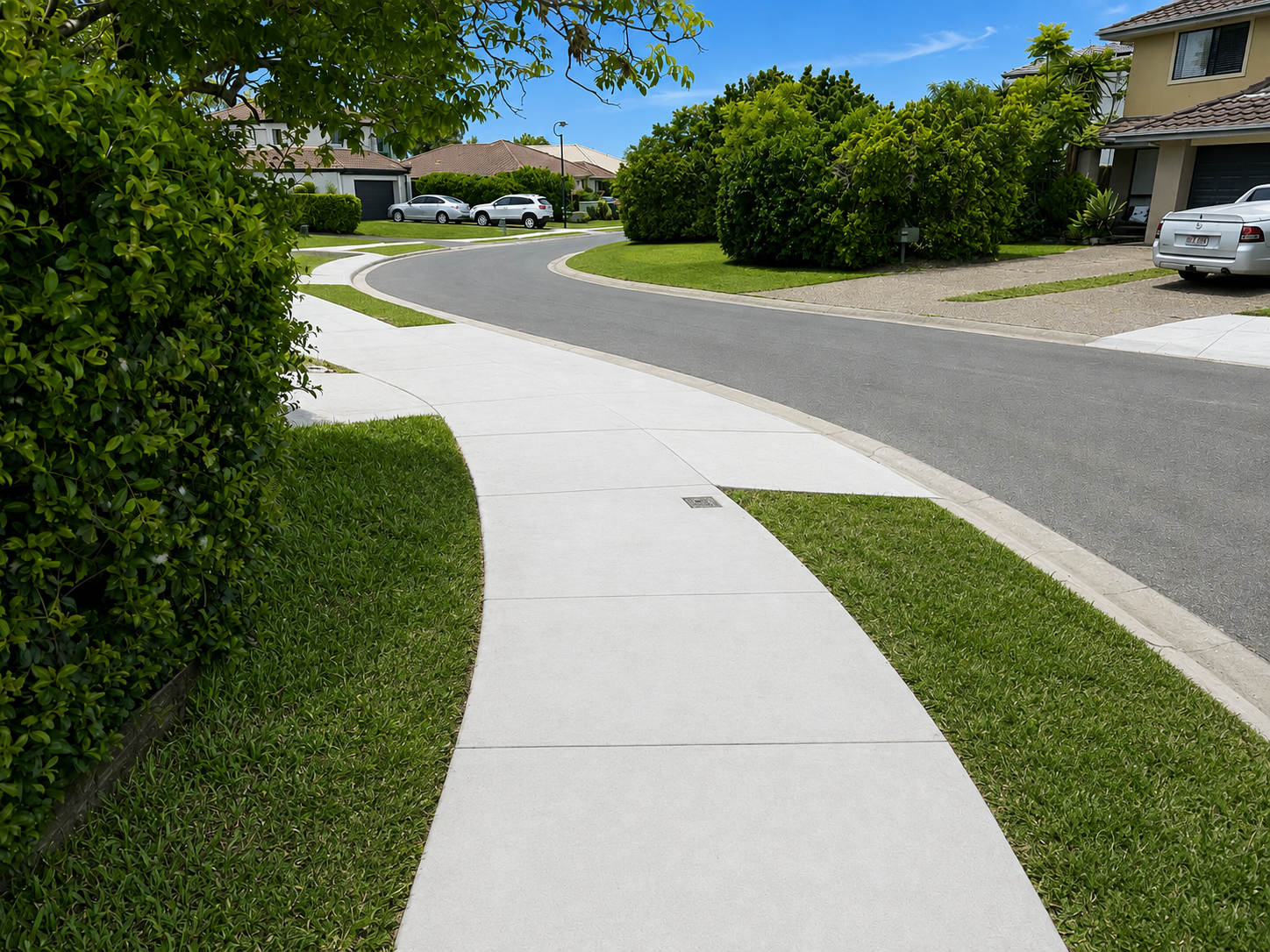
Serafina Drive demonstrates why concrete replacement is often an infrastructure and staging exercise, not simply a concrete pour.
Another Real-World Lesson: Replacement Lets You Correct More Than the Surface
OSM’s Leverett Residence project at Tallebudgera is residential rather than commercial, but the construction lesson applies directly to commercial pavement replacement.
More than 400m² of deteriorated asphalt was removed before a new reinforced concrete driveway system was built. The project did not stop at replacing the visible pavement. It also involved sub-base work, regrading, crossover works, culvert construction, drainage improvements and earthworks.
That is the advantage of taking a failed pavement back far enough to correct the system.
If water management, grades or support are contributing to a pavement problem, replacing only the top surface leaves the contractor trying to build a new outcome on old geometry.
When a Rapid Repair Is Better Than Replacement
Technical replacement knowledge also means knowing when not to demolish a serviceable slab.
Some commercial pavement defects are genuinely local and occur in areas where reopening time is critical. Specialised rapid reinstatement mortars exist for exactly that reason.
For example, Fosroc’s Australian Renderoc Rapid is designed for localised repairs to pavement, floors and joint areas. The manufacturer lists application depths from 25mm to 250mm and states that the product can accept traffic approximately one to two hours after placement under the nominated product conditions.
That does not mean every commercial concrete repair can reopen in two hours.
It means there are circumstances where the correct rapid-repair system can solve a local defect without the cost and disruption of replacing a much larger sound slab.
Programming point: reopening times should always come from the selected system, site temperature, repair geometry, project specification and current technical data sheet. Do not assume the cure time for a rapid repair mortar applies to conventional replacement concrete.
Why Repeated Cheap Repairs Can Become the Expensive Option
Repair normally has a lower initial scope because less material is removed and less new concrete is placed.
That does not automatically make it the lowest-cost decision over the life of the asset.
Commercial concrete carries indirect costs as well. There may be traffic management, pedestrian diversions, tenancy disruption, site supervision, mobilisation, temporary barricades, after-hours access and repeated inspections every time the same defect returns.
If a $1 repair decision has to be made three or four times while the underlying movement continues, the comparison with a $3 replacement decision changes quickly.
This is particularly relevant to strata committees and facility managers managing maintenance budgets over several years.
OSM’s concrete maintenance guide for Gold Coast strata, schools, plazas and public spaces takes the same asset-management approach: repair a local problem, resurface a stable but worn slab, and consider replacement when the concrete is no longer providing a reliable base for either treatment.
Live Sites Change the Replacement Strategy
A technically good replacement plan can still be a poor commercial plan if it shuts down the wrong accessway at the wrong time.
Shopping centres, schools, strata complexes, theme parks, workshops, warehouses and public facilities often have to remain operational while concrete work is completed.
That changes how replacement areas should be selected and sequenced.
The contractor may need to maintain one vehicle lane while another is replaced, retain pedestrian access to a tenancy, schedule demolition outside peak operating hours or divide a large pavement into logical stages so that deliveries can continue.
Curing also needs to be built into that sequence. A replacement slab cannot be returned to its design traffic simply because finishing was completed yesterday. The programme needs to allow the concrete to develop the required performance before the area is loaded.
This is one reason OSM’s experience across theme parks and public spaces, strata concrete maintenance and civil concrete projects is relevant to commercial replacement work. These environments often require staging and access management alongside the concrete itself.
What About Spalling and Reinforcement Corrosion?
This requires a little more care than a normal surface repair.
When reinforcement corrodes, the products of corrosion can occupy more volume than the original steel. That expansion can crack and dislodge the surrounding concrete, creating the spalling often seen on older reinforced structures.
Repair systems exist specifically for this work. Some include corrosion-protection coatings for exposed reinforcement, polymer-modified repair mortars and low-permeability reinstatement materials.
For example, Sika’s current Australian MonoTop repair system includes MonoTop-910 N for reinforcement corrosion protection and bonding, together with structural repair mortars for reinstatement.
However, major reinforcement corrosion, structural deterioration, balconies, columns, suspended slabs and other load-bearing structural elements can require specialist remedial investigation and engineering.
This article is primarily concerned with the repair and replacement decision for commercial pavements, access areas, pathways, hardstands, strata surfaces, external slabs and similar concrete assets. Structural remediation should be assessed according to its own engineering requirements.
The Gold Coast Adds Its Own Failure Conditions
Commercial concrete on the Gold Coast can experience a demanding combination of heat, heavy rainfall, wet-dry cycling, coastal exposure, traffic and rapid site development.
But local climate should not become an excuse for every crack.
Good diagnosis still needs to separate environmental exposure from construction and support problems.
A slab that repeatedly ponds may have a level problem. A pavement breaking at the same wheel path may have a loading or support issue. Cracks forming through several adjoining panels may indicate movement or jointing conditions. Local edge damage beside a service route may simply be an impact or traffic problem.
Different causes need different solutions.
How OSM Decides Whether Concrete Is Worth Keeping
OSM does not need to automatically recommend replacement because the company also works with repairs and resurfacing. That gives the project team the ability to compare more than one practical treatment.
The assessment starts by determining how much of the existing concrete still has value.
If the slab is stable and the problem is primarily visual or surface-related, commercial concrete resurfacing may retain the existing concrete while providing a new surface.
If the defect is genuinely local, targeted repair may provide the best outcome.
If the slab has broken into multiple moving sections, settled, lifted, lost support, developed serious drainage problems or repeatedly failed after previous repairs, full-depth concrete replacement gives the contractor access to the parts of the system that repair materials cannot reach.
That is the decision that matters.
What Should a Commercial Concrete Site Assessment Look At?
A useful site assessment should examine more than the damaged square metres shown on a plan.
The contractor needs context.
That can include the pattern of cracking, changes in elevation, joint locations, evidence of movement, drainage direction, ponding, traffic paths, edge loading, previous repairs, underground services, access for demolition equipment, retained structures, site operating hours and how replacement areas would tie back into existing concrete.
For larger or more complex projects, survey information, engineering drawings, previous pavement details and service plans may all help explain why the slab is behaving the way it is.
OSM site-assessment principle: the objective is not simply to identify damaged concrete. It is to work out which concrete can realistically remain in service and which concrete is preventing the site from achieving the required safety, drainage, traffic or durability outcome.
Concrete Repair vs Replacement Decision Matrix
| Site condition | Repair | Resurface | Replace |
|---|---|---|---|
| Local stable crack | Often worth investigating | Possible after appropriate treatment if the whole surface also needs renewal | Usually excessive unless other defects exist |
| Local spall in otherwise sound slab | Often suitable | Possible after repair | May be unnecessary |
| Stable slab with widespread surface wear | May address isolated defects | Strong candidate | Often unnecessary |
| Sunken or rocking panel | Does not directly correct lost support | Poor candidate until movement is resolved | Often preferred |
| Incorrect falls and persistent ponding | Limited ability to correct geometry | Only suitable where levels can genuinely be corrected within the system | Often provides the strongest opportunity to reset levels |
| Repeated crack repair failure | Investigate cause before repairing again | Usually unsuitable while movement continues | May be better if movement or support is the underlying issue |
| Multiple fractured panels under traffic | Can become an inefficient patchwork programme | Not suitable over unstable concrete | Strong candidate |
| Failed concrete over unstable base | Does not reach the primary defect | Not appropriate until support is corrected | Usually required to access and rebuild the base |
Commercial Concrete Repair and Replacement FAQs
Is it cheaper to repair concrete or replace it?
A local concrete repair usually has a lower initial cost because less concrete is demolished and replaced. Replacement can offer better whole-of-life value when the slab is moving, sinking, repeatedly cracking or has underlying base and drainage problems that a surface repair cannot correct.
Can badly cracked commercial concrete be repaired?
Sometimes. The important issue is why it cracked. A stable local crack may be repairable using a suitable system. Multiple cracks caused by slab movement, settlement or poor support are different because repairing the crack does not remove the movement causing it.
What is a full-depth concrete repair?
A full-depth repair removes the concrete through the complete thickness of the slab in a defined area and replaces that section. It is different from partial-depth patching, which only removes and reinstates part of the slab thickness.
Can only one section of a commercial slab be replaced?
Yes. Full replacement does not automatically mean demolishing an entire carpark, driveway or pathway. Failed panels or logical pavement sections can often be replaced while suitable surrounding concrete is retained.
Can resurfacing be used instead of concrete replacement?
Yes, when the existing slab remains stable and the main problem is surface wear, appearance, texture or localised surface deterioration. OSM provides commercial concrete resurfacing and repairs as an alternative where retaining the original slab makes technical and commercial sense.
How quickly can repaired commercial concrete return to service?
It depends entirely on the selected system. Some specialised rapid pavement repair mortars are designed for very fast traffic return, while conventional repair mortars and replacement concrete have different curing and strength-development requirements. The programme should follow the actual product and project specification.
Does OSM replace concrete at strata and body corporate properties?
Yes. OSM completes concrete replacement and maintenance work for strata and body corporate sites, including shared driveways, pathways, ramps, access areas and other high-use common-property concrete.
The Best Concrete Repair Is Sometimes Knowing Not to Repair It
Commercial concrete rectification is not about finding the strongest patching compound or covering every crack.
It is about understanding the failure deeply enough to choose the least invasive solution that can realistically provide the required service life.
Sometimes that is a small repair.
Sometimes a stable slab should be retained and resurfaced.
Sometimes failed panels should be selectively removed through their full depth.
And sometimes the most economical long-term decision is to stop repairing a pavement that has already demonstrated that its base, levels or slab system are no longer reliable.
With experience across commercial concrete, civil works, strata maintenance, resurfacing and repairs and concrete replacement, OSM can assess the existing concrete without forcing every site into the same treatment.
You can also view OSM’s completed Gold Coast concrete projects to see the different approaches used across civil, commercial, public-space, resurfacing and replacement work.
Have Commercial Concrete That Keeps Cracking, Sinking or Failing?
If you manage a commercial property, strata complex, public facility, school, development or high-use concrete area on the Gold Coast, OSM Concrete can assess whether the better solution is targeted repair, resurfacing, partial full-depth replacement or complete concrete replacement.
Send the project team photographs, plans, site details or an outline of the problem. The more OSM understands about the cracking, traffic, drainage and previous repairs, the more useful the initial assessment can be.
Request a Commercial Concrete Assessment